Category: Blog Post

  • AI and Machine Learning: Transforming B2B Marketing

    AI and Machine Learning: Transforming B2B Marketing

    AI and machine learning in B2B - Featured image for Discovr

    The New Frontier: AI and Machine Learning in B2B Marketing

    In a world driven by technological innovation, AI and machine learning in B2B marketing aren’t just passing fads; they’re becoming essential for success. A recent McKinsey survey found that 70% of companies anticipate making AI a major part of their marketing strategy within the next five years. For B2B marketers, the challenge lies in effectively incorporating these powerful tools into their existing frameworks. This blog post will explore how AI and machine learning can redefine your marketing strategies, optimize customer interactions, and boost lead generation.

    Table of Contents

    1. Understanding AI and Machine Learning in B2B
    2. Key Applications of AI in B2B Marketing
    3. Overcoming Challenges with AI Implementation
    4. Best Practices for Leveraging AI in B2B Marketing
    5. The Future of AI and Machine Learning in B2B Marketing
    6. Conclusion

    Understanding AI and Machine Learning in B2B

    What is AI and Machine Learning?

    Artificial Intelligence (AI) is all about mimicking the processes of human intelligence using machines, particularly computer systems. This encompasses learning, reasoning, problem-solving, perception, and understanding language. Machine learning, a branch of AI, focuses specifically on a machine’s ability to learn from data and improve its performance over time without having to be programmed manually.

    Why B2B Marketing Needs AI and Machine Learning

    B2B marketing entails complex decision-making, lengthy sales cycles, and multiple stakeholders. Here are a few compelling reasons to integrate AI and machine learning into your strategy:

    1. Data-Driven Insights: With the sheer volume of data generated daily, AI tools can sift through this information and highlight valuable insights that might otherwise go unnoticed.
    2. Personalization: Machine learning algorithms tailor marketing messages based on customer behavior and preferences, leading to improved engagement.
    3. Efficiency: Automating repetitive tasks allows marketing teams to focus on strategy and creativity instead of getting bogged down in the minutiae.

    Key Applications of AI in B2B Marketing

    1. Enhanced Lead Scoring

    AI and machine learning empower marketers to examine historical customer data and spot trends that indicate when a lead is ready to convert. This capability helps teams to:

    • Focus on high-quality leads that are more likely to make a purchase.
    • Allocate leads intelligently among sales representatives.

    2. Predictive Analytics

    Predictive analytics takes historical data and uses it to forecast future trends and behaviors. By leveraging AI-driven predictive models, businesses can:

    • Anticipate consumer needs and tweak marketing strategies accordingly.
    • Boost inventory management and supply chain logistics based on anticipated demand.

    3. Chatbots and Virtual Assistants

    AI-powered chatbots can significantly elevate customer support and lead generation. These tools excel at:

    • Providing immediate responses to inquiries, improving customer satisfaction.
    • Qualifying leads through automated conversations, effectively filtering prospects.

    4. Content Creation and Curation

    AI technologies like natural language processing (NLP) help in content generation by:

    • Analyzing existing content to find gaps and opportunities.
    • Creating reports, blog posts, and social media updates that respond to current trends.

    5. Account-Based Marketing (ABM)

    ABM strategies reap the benefits of AI by pinpointing key accounts that are likely to engage and convert. Through data analysis, marketers can:

    • Craft personalized campaigns that resonate with the unique needs of target accounts.
    • Measure and optimize the effectiveness of campaigns in real time.

    Overcoming Challenges with AI Implementation

    Despite the immense potential of AI and machine learning in B2B marketing, organizations may encounter a few hurdles:

    Data Quality

    The effectiveness of AI and machine learning initiatives is heavily reliant on high-quality data. Flawed data can lead to inaccurate predictions and insights. Companies should invest in tools to clean and manage data, ensuring their datasets remain reliable.

    Integration with Existing Systems

    Bringing new AI technologies into existing marketing systems can be a bit tricky. It’s important to choose solutions that can seamlessly connect with Customer Relationship Management (CRM) and marketing automation tools.

    Skill Gaps

    Many marketing teams may not have the necessary expertise to implement AI effectively. Organizations should think about investing in training or hiring specialists in AI to fully harness its advantages.

    Best Practices for Leveraging AI in B2B Marketing

    1. Define Clear Objectives

    Before diving into AI implementation, it’s crucial for organizations to set specific goals. Whether your aim is to enhance lead quality, improve customer experience, or boost campaign efficiency, having clear objectives will provide direction for your efforts.

    2. Start Small, Scale Gradually

    Kick things off with a pilot project focused on one aspect of your marketing strategy, like lead scoring. As you gather insights and results from this initial effort, you can gradually extend your AI applications to other areas of your marketing strategy.

    3. Foster a Data-Driven Culture

    Encourage your teams to embrace a data-driven mindset. Promote regular discussions around performance metrics and align marketing strategies with customer behaviors and preferences.

    The Future of AI and Machine Learning in B2B Marketing

    Emerging technologies will only deepen the connection between AI and machine learning with B2B marketing. Businesses that adopt these innovations today position themselves ahead of the competition. Statista predicts that AI in marketing could reach approximately $40 billion by 2027. Creating a tech-savvy culture that welcomes change will be essential for B2B organizations.

    Frequently Asked Questions

    Q1: What distinguishes machine learning from general AI in B2B marketing?
    A1: Machine learning is a branch of AI focused on enabling machines to learn from data and improve without manual programming, whereas AI broadly mimics human intelligence processes.

    Q2: How does AI improve lead scoring in B2B marketing?
    A2: AI examines historical data to identify trends signaling when a lead is likely to convert, helping marketers focus on high-quality leads and allocate resources efficiently.

    Q3: What are common challenges companies face when implementing AI in marketing?
    A3: Challenges include ensuring high-quality data, integrating AI with existing systems, and addressing skill gaps within marketing teams.

    Q4: Why is starting with a pilot project recommended when adopting AI in B2B marketing?
    A4: Starting small allows organizations to gather insights and measure success before scaling AI applications, reducing risks and improving implementation effectiveness.

    Q5: How can AI-driven chatbots enhance B2B marketing efforts?
    A5: Chatbots improve customer support by providing immediate responses and help in lead qualification through automated conversations.

    Conclusion

    AI and machine learning are set to reshape the world of B2B marketing. By embracing these advanced technologies, marketers can enhance lead generation strategies, personalize customer interactions, and glean insights that drive crucial decisions. As you consider the potential of AI, remember that leveraging technology is about more than just improving processes; it’s about changing your approach to connect with your audience on a deeper level. If you’re ready to elevate your B2B marketing strategies, Discovr is here to guide you through this transformative journey. Learn more about us and see how we can help you make the most of AI for your business. Research from Statista shows that AI in marketing continues to gain traction, with significant growth expected in the coming years.
  • The Benefits of an AI Marketing Employee for Small Teams

    The Benefits of an AI Marketing Employee for Small Teams

    AI marketing employee benefits - Featured image for Discovr

    The Benefits of an AI Marketing Employee for Small Teams

    Picture this: a small marketing team grappling with a mountain of digital campaigns, content creation, and customer engagement strategies. Sound familiar? If you’re tired of juggling multiple tasks with limited resources, it’s time to meet your new best friend—the AI marketing employee. This innovative tool can truly change the game for small teams, boosting productivity and strategic effectiveness. In this post, we’ll take a closer look at the perks of integrating artificial intelligence into your marketing workflow and how it can lead to greater success.

    Table of Contents

    1. Understanding AI in Marketing
    2. Key Benefits of an AI Marketing Employee
    3. Common Applications of AI in Marketing
    4. Addressing Concerns Around AI Integration
    5. Real-World Examples of Successful AI Implementation
    6. Future Trends in AI Marketing
    7. Conclusion

    Understanding AI in Marketing

    What is an AI Marketing Employee?

    An AI marketing employee refers to tools and systems powered by artificial intelligence that assist marketing professionals. These solutions handle a variety of tasks, from data analysis to customer interactions, ultimately streamlining marketing operations while enhancing overall effectiveness.

    Key Benefits of an AI Marketing Employee

    1. Enhanced Efficiency and Productivity

    Small teams often feel stretched thin, but introducing an AI marketing employee can significantly relieve this burden. Here’s how:

    • Automation of Repetitive Tasks: Think about tedious tasks like segmentation, targeting, and campaign management. AI can handle these effortlessly, allowing your team to channel their energy into strategy and creativity.
    • Faster Data Processing: AI systems are capable of analyzing large datasets at remarkable speed, delivering insights that would take a human team days to compile.
    • 24/7 Availability: With AI-driven chatbots and marketing tools, customer engagement and data collection can take place around the clock—meaning no potential lead is left unattended.

    2. Data-Driven Decision Making

    For small teams with tight budgets, making informed decisions is crucial. AI marketing employee benefits include enhanced data analytics capabilities that empower your team:

    • Predictive Analytics: By analyzing historical data, AI can predict future trends, allowing teams to customize their strategies for optimized performance.
    • Real-time Insights: AI tools provide real-time analytics, enabling marketers to adjust campaigns on the fly based on audience engagement.
    • Customer Insights: AI analyses consumer behavior and preferences, uncovering new opportunities and market segments that might have been missed.

    3. Cost-Effectiveness

    Investing in AI marketing solutions can lead to substantial savings for small businesses. Here’s why:

    • Reduced Labor Costs: AI can take over mundane tasks, helping teams operate with fewer members while maintaining—or even increasing—their output.
    • Increased ROI: By using AI tools effectively, you can create better-targeted campaigns, resulting in higher conversion rates and maximizing your marketing budget.
    • Scalability: As your business grows, AI tools can seamlessly scale with your operations, eliminating the need for constant hiring and training.

    Common Applications of AI in Marketing

    1. Content Creation and Curation

    AI tools can be a big help in generating content ideas, automating social media posts, and even writing basic articles. Here are some common applications:

    • Keyword Optimization: AI can recommend keywords that resonate with current trends and audience interests.
    • Content Personalization: Using data insights, AI can customize content for individual users, enhancing their engagement.

    2. Email Marketing Automation

    AI marketing employee benefits extend to email campaigns as well:

    • Automated Segmentation: AI can help you categorize customers into tailored groups based on their behaviors and preferences.
    • Subject Line Testing: AI can identify the most effective subject lines through A/B testing, improving open rates and engagement.

    3. Social Media Management

    AI tools can elevate your social media strategies by:

    • Performance Tracking: Analyzing metrics to determine which content resonates best with your audience.
    • Sentiment Analysis: Evaluating audience reactions to measure brand perception and adapt messaging accordingly.

    Addressing Concerns Around AI Integration

    1. Adoption Challenges

    While the perks of AI are substantial, small teams may encounter hurdles such as:

    • Training Time: Team members might need time to learn how to navigate AI tools effectively.
    • Integration Issues: Ensuring that AI systems seamlessly cooperate with existing marketing technologies can present challenges.

    2. Maintaining Human Touch

    One common concern is that AI could overshadow the human element in marketing. It’s essential to remember:

    • AI as a Tool, Not a Replacement: AI enhances human capabilities, allowing marketers to concentrate on strategy and creativity instead of being bogged down by repetitive tasks.
    • Balancing Automation with Personalization: The most effective marketing strategies will always mix automation with personal touches to cultivate meaningful customer relationships.

    Real-World Examples of Successful AI Implementation

    Several small teams are already reaping the rewards of AI in their marketing strategies:

    • BuzzFeed: They harnessed AI to analyze reader preferences, resulting in more engaging and relevant content.
    • EasyJet: The europe-based airline built a cloud-based conversation interface its customers could interact with through speech with a 99.8% accuracy rate on 5 million+ queries.
    • WeWire: They deployed AI Agents to automate lead responses and dramatically increase conversion rates.

    The future of marketing is certainly linked with advancements in AI. Here’s what to keep an eye on:

    • Increased Personalization: As AI technology develops, expect more sophisticated, tailor-made marketing experiences.
    • Voice and Language Processing: AI marketing tools will likely start leveraging voice search and natural language processing (NLP) for better customer interaction.
    • Augmented Analytics: Future AI systems may deliver even deeper insights, blending data science with enhanced machine learning capabilities.

    Frequently Asked Questions

    Q1: What is an AI marketing employee?
    A1: It refers to AI-powered tools and systems that assist marketing teams by automating tasks like data analysis and customer engagement.

    Q2: How can AI improve efficiency for small marketing teams?
    A2: AI automates repetitive tasks, processes data faster, and provides 24/7 availability for customer interactions, freeing up team members for strategic work.

    Q3: What are some common uses of AI in marketing?
    A3: Common applications include content creation and curation, email marketing automation, and social media management such as performance tracking and sentiment analysis.

    Q4: Are there challenges in adopting AI for small teams?
    A4: Yes, challenges include the time needed for training and potential integration issues with existing marketing technologies.

    Q5: Does AI replace the human element in marketing?
    A5: No, AI is a tool designed to enhance human creativity and strategy, not to replace personal touches needed for effective customer relationships.

    Conclusion

    Integrating an AI marketing employee into a small team can transform marketing strategies and overall team effectiveness. From boosted efficiency and cost savings to data-driven decision-making, the benefits are clear. As small teams face the challenges of limited resources, embracing AI is becoming essential.

    Ready to elevate your marketing strategy? Discover how Discovr can help your small team tap into the benefits of an AI marketing employee for optimized operations and success.

    Research from Statista shows that AI is increasingly crucial in marketing strategies, giving small businesses the chance to optimize their operations effectively.

  • The Benefits of Using AI for B2B Marketing Automation

    The Benefits of Using AI for B2B Marketing Automation

    B2B marketing automation with AI - Featured image for Discovr

    The Transformative Power of B2B Marketing Automation with AI

    In a world where a staggering 80% of marketers report feeling overwhelmed by their workload, it’s vital to seek innovative solutions that streamline processes while still achieving effective results. Enter B2B marketing automation with AI—a game-changer that’s reshaping the landscape for businesses. Offering unmatched efficiency, strategic insights, and cost-effectiveness, this technology is ideal for everyone from solo marketers to bustling agencies and ambitious startup founders. Let’s explore how AI-driven marketing automation can elevate your engagement with your audience and supercharge your campaigns.

    Table of Contents

    1. Understanding B2B Marketing Automation with AI
    2. Key Benefits of B2B Marketing Automation with AI
    3. Common Use Cases of AI in B2B Marketing Automation
    4. How to Implement B2B Marketing Automation with AI
    5. Conclusion: Embrace the Future of Marketing

    Understanding B2B Marketing Automation with AI

    What is B2B Marketing Automation?

    B2B marketing automation involves utilizing software platforms and tools designed to autonomously handle repetitive tasks across various marketing channels. Whether it’s managing email campaigns, posting on social media, generating leads, or tracking analytics, these tools streamline processes significantly. By integrating AI, businesses can boost their automation capabilities, uncover valuable insights, and personalize marketing efforts on an entirely new level.

    How AI Enhances Marketing Automation

    AI technologies harness machine learning algorithms and data analytics to refine and personalize marketing processes. This powerful integration allows businesses to:

    • Analyze Data: AI can swiftly sift through vast amounts of data to uncover trends, customer preferences, and potential opportunities.
    • Predict Outcomes: With predictive analytics at its helm, AI can enhance marketers’ ability to forecast campaign success, enabling more informed planning.
    • Automate Content Creation: Need a blog post, email, or social media update? AI tools can generate content uniquely tailored to specific audience segments, dramatically cutting down the time spent on creation.

    Key Benefits of B2B Marketing Automation with AI

    1. Enhanced Efficiency and Time Savings

    For marketing professionals like Laila, the lone wolf in B2B SaaS marketing, AI can manage the bulk of everyday repetitive tasks. Scheduling campaigns, sending email confirmations, and generating analytics reports become effortless, allowing her to focus on strategic decision-making and creative brainstorming. Meanwhile, agencies like Mike’s can leverage AI to juggle multiple client campaigns without constantly switching gears—a major win for productivity.

    2. Cost-Effective Scaling

    Budget constraints can stifle growth for many businesses, including startups like Peter’s B2B SaaS venture. Fortunately, B2B marketing automation solutions make it possible to scale marketing efforts without a corresponding spike in costs. By replacing various roles, these AI-driven tools help reduce overhead expenses usually associated with hiring additional staff, paving the way for more sustainable growth.

    3. Personalization at Scale

    Today’s B2B customers expect personalized experiences that cater to their individual needs and challenges. AI empowers marketers to craft hyper-personalized campaigns based on user behavior and preferences. By tapping into data from CRM systems, marketers can design engaging emails, landing pages, and content that resonate deeply with each audience segment, leading to significant boosts in engagement and conversion rates.

    4. Improved Data-Driven Decisions

    One of the standout advantages of incorporating AI into marketing automation is the power to make informed, data-driven decisions. AI systems continuously analyze real-time data, providing actionable insights that refine strategies on the go. Imagine being able to evaluate a campaign’s performance continuously—this allows you to make adjustments based on real-time feedback and data-driven insights.

    Common Use Cases of AI in B2B Marketing Automation

    Email Marketing Automation

    With the help of AI, businesses can automate their email marketing campaigns by customizing messages for specific segments and optimizing send times based on user behavior. This tailored approach leads to dramatically increased open rates and engagement. In fact, personalised email messages improve click-through rates by an average of 14% and boost conversions by 10%. In my experience automating marketing and sales, it can boost open rate to warm leads by another 200%.

    Lead Scoring

    AI-driven lead scoring takes the guesswork out of prioritizing leads effectively. By analyzing customer interactions and engagement levels, AI can classify leads based on their likelihood to convert. This means sales teams spend more time cultivating relationships with high-potential leads, which enhances productivity and boosts closing rates.

    Chatbots for Customer Engagement

    Implementing AI-powered chatbots can significantly enhance customer service by providing instant responses to inquiries. Not only does this improve the customer experience, but it also streamlines lead generation. Chatbots can qualify leads and forward them directly to sales teams, ensuring potential clients receive timely attention and support.

    How to Implement B2B Marketing Automation with AI

    Define Your Goals

    Before diving into AI integration, it’s crucial to define specific goals you want to achieve. This might include boosting lead conversion rates, enhancing customer engagement, or fine-tuning campaign performance.

    Select the Right Tools

    Choosing the right AI-powered marketing automation tools is essential. Seek out platforms that provide a variety of features aligned with your business needs. Whether you need robust analytics capabilities, help with content generation, or CRM integration, selecting the right software is vital for the success of your strategy. Not to toot our own horn, but Echomarketer AI does a pretty good job automating difficult and repetitive tasks in B2B Marketing with AI, while also giving deep insights for business growth. Try it today!

    Monitor and Optimize

    Regularly monitoring the performance of your AI systems and marketing campaigns is crucial for ongoing success. Utilizing analytics tools will provide insight into what’s working and what needs adjusting. Use these insights to continually refine your approach and achieve better results.

    Frequently Asked Questions

    Q1: What tasks can B2B marketing automation with AI handle?
    A1: It can manage repetitive tasks such as scheduling campaigns, sending emails, generating analytics reports, posting on social media, lead scoring, and customer engagement through chatbots.

    Q2: How does AI improve personalization in marketing?
    A2: AI analyzes user behavior and preferences from CRM data to craft hyper-personalized campaigns, resulting in higher engagement and conversion rates.

    Q3: Why is choosing the right AI tools important?
    A3: Selecting tools that align with your business needs, such as content generation or robust analytics, ensures more effective and successful marketing automation.

    Q4: What benefits does AI bring to decision-making in marketing?
    A4: AI continuously analyzes real-time data to provide actionable insights, allowing marketers to adjust strategies dynamically and improve campaign performance.

    Conclusion: Embrace the Future of Marketing

    Integrating B2B marketing automation with AI is no longer a luxury—it’s a necessity in the modern marketing landscape. By streamlining processes, cutting overhead costs, and offering personalized experiences at scale, marketers can drive better results with less effort. For anyone feeling the pressure like Laila, Mike, or Peter, exploring solutions like Discovr can provide the support needed to elevate your marketing efforts.

    As you contemplate the transformative potential AI brings to your marketing strategy, don’t hesitate to take the leap into automation. The benefits for your business are immense, paving the way for growth and success in an ever-evolving marketplace.

  • Building a Sustainable B2B Marketing Strategy with AI Insights

    Building a Sustainable B2B Marketing Strategy with AI Insights

    sustainable B2B Marketing Strategy with AI - Featured image for Discovr

    Understanding the Intersection of AI and Sustainable B2B Marketing

    As a marketing manager in the B2B SaaS industry, you may sometimes feel like you’re juggling a dozen tasks at once; managing campaigns, analyzing data, and crafting engaging content, all while trying to keep your sanity intact. The traditional marketing processes can feel overwhelming, especially for solo warriors and small teams. But what if there was a way to weave sustainability into your marketing fabric, all while harnessing the power of AI? A sustainable B2B marketing strategy powered by AI insights isn’t just a figment of imagination; it’s a crucial component for thriving in today’s competitive marketplace.

    Table of Contents

    1. The Role of AI in Sustainable B2B Marketing
    2. Implementing AI-Based Insights into Your Marketing Strategy
    3. Real-World Applications of AI in B2B Marketing
    4. The Benefits of Building a Sustainable B2B Marketing Strategy with AI
    5. The Future of B2B Marketing: AI and Sustainability
    6. Concluding Thoughts

    The Role of AI in Sustainable B2B Marketing

    What Does a Sustainable B2B Marketing Strategy Look Like?

    At its core, a sustainable B2B marketing strategy operates on efficient resource use and waste reduction, all while maximizing impact. This is where AI swoops in as a game-changer. It allows businesses to automate mundane tasks, streamline processes, and make decisions rooted in real-time data. By integrating AI, companies can nimbly adapt their strategies, ensuring they stay effective and resource-conscious.

    Key Components of a Sustainable B2B Marketing Strategy

    1. Data-Driven Decision Making: Employing AI tools for market analysis helps unearth trends and customer preferences. This approach enhances campaign effectiveness and minimizes waste—always a win-win!
    2. Content Personalization: AI empowers marketers to deliver tailored content suited for diverse audience segments. Personalized messaging can significantly boost engagement rates, ensuring every marketing dollar is wisely spent.
    3. Automation of Repetitive Tasks: Automation frees up time and brainpower, enabling marketing professionals to concentrate on strategic initiatives rather than getting bogged down by tedious tasks. Just ask Laila, the overworked marketing manager who thrives when given the tools to simplify her workload.
    4. Scalable Marketing Solutions: For startup founders like Peter, scalability is paramount. A well-executed AI strategy allows businesses to enlarge their marketing outreach without incurring proportional costs.

    Implementing AI-Based Insights into Your Marketing Strategy

    How to Start Using AI in Your B2B Marketing Efforts

    1. Identify Your Needs: Begin by pinpointing areas in your marketing strategy where AI can lighten your load. For agencies like Mike’s, that could mean investing in SEO tools or email automation software.
    2. Choose the Right Tools: Remember, not all AI tools are created equal. Seek out platforms offering robust analytics, CRM integration such as Seamless.AI, Cognism, Apollo.io, HubSpot AI; marketing automation like Make, N8N, Latenode, or Zapier to create a seamless workflow; and automated SEO and organic content creation such as Discovr AI.
    3. Train Your Team: Ensure your team is well-equipped to harness the capabilities of AI tools. Consider investing in training sessions or workshops that focus on leveraging technology effectively in AI-driven marketing.
    4. Monitor and Adjust: Establish key metrics to evaluate how well your AI-supported marketing efforts are performing. Regular check-ins and adjustments will help you continuously optimize your strategy.

    Real-World Applications of AI in B2B Marketing

    Case Study: Success Stories of AI Adoption

    Many B2B companies have successfully integrated AI into their marketing strategies, demonstrating the effectiveness of a sustainable approach. Here are a few standout examples:

    • Automated Lead Scoring: Organizations harnessing AI tools to prioritize leads have noticed a significant bump in conversion rates. By evaluating multiple data points, AI can score leads based on their likelihood to become customers.
    • Enhanced Customer Insights: AI-driven analytics can reveal subtle trends in customer behavior, enabling businesses to tailor their marketing strategies with precision.
    • Predictive Analytics: Companies utilizing AI-powered predictive analytics have been able to forecast market trends and customer actions, allowing them to proactively adjust strategies.

    The Benefits of Building a Sustainable B2B Marketing Strategy with AI

    Key Advantages

    1. Increased Efficiency: Automating resource-heavy tasks allows businesses to allocate effort more effectively, reducing the pressure on individuals like Laila who juggle various responsibilities.
    2. Cost-Effectiveness: For organizations looking to keep overhead expenses in check, an AI-based strategy offers a pathway to enhance marketing effectiveness without the need to expand the team. Take Discovr, for instance; it serves as a virtual employee, optimizing resources.
    3. Improved Customer Engagement: Tailored content and proactive outreach resonate more powerfully with clients, leading to enhanced loyalty and increased repeat business.
    4. Sustainability: A focus on resource efficiency aligns with broader sustainability goals, allowing businesses to minimize waste and make positive contributions to their industries.

    The Future of B2B Marketing: AI and Sustainability

    • Increased AI Adoption: As technology evolves, the reliance on AI in B2B marketing will continue to rise. Early adopters who embrace this trend will likely secure a competitive edge.
    • Greater Personalization: As consumers yearn for more personalized experiences, AI will enable hyper-customization, allowing companies to transcend basic segmentation.
    • Data Privacy and Ethics: With growing awareness around data privacy, businesses must navigate the fine line between leveraging AI for insights and respecting customer data preferences.

    Concluding Thoughts

    Integrating a sustainable B2B marketing strategy with AI insights isn’t merely optional; it’s essential for companies aiming for success in today’s competitive landscape. By embracing AI in your marketing efforts, businesses can automate processes, enhance customer engagement, and ultimately drive better results.

    If you’re a marketing manager feeling swamped or an agency owner grappling with operational costs, exploring solutions like Discovr could be a game-changing step toward greater efficiency and sustainability. By welcoming AI into your toolkit, you’re not just keeping pace with trends—you’re laying the groundwork for a robust, future-ready marketing strategy.

    Ready to empower your marketing with AI? Discover how Discovr can act as your virtual marketing employee and revolutionize your B2B marketing efforts today. Visit Discovr now!

  • WILL AI REPLACE DIGITAL MARKETERS? No Sugar-Coating Answer & Prediction

    WILL AI REPLACE DIGITAL MARKETERS? No Sugar-Coating Answer & Prediction

    Discovr AI - WILL AI REPLACE DIGITAL MARKETERS?

    WILL AI REPLACE DIGITAL MARKETERS?

    For many people, AI is this exciting tech they love to use but quietly feel threatened by. It’s a mix of fascination and fear they don’t quite want to admit. In corporate settings, some push back against it because of a deeper fear of losing relevance.

    Most are secretly using it to work faster and produce better results… while pretending not to, because it might reduce the perceived value of their “natural” skills.

    Because of this quiet tension, almost everyone keeps asking the same question: “Will AI replace digital marketers?”

    For this post, I’ll answer it as honestly as possible — no sugar-coating.

    As an experienced marketer and entrepreneur who’s built AI systems to automate parts of my own marketing, I can confidently say: “Current AI will completely change digital marketing and automate many tasks — but it won’t completely replace digital marketers.”

    Right now, AI is already changing the game.
    It’s making marketers move faster, making young professionals sharper, making brainstorming easier, and making work more efficient overall.

    Here’s what I predict will happen over the next few years:

    • AI will reduce the number of marketing employees per organization — but at the same time, it’ll help more companies get built faster.
    • So in a weird way, it levels the field again.
    • The traditional agency model will likely shrink, while solo-marketer and fractional CMO opportunities will grow.
    • New roles will emerge — think Marketing Systems Designer or AI-First Marketer.
    • Digital marketers will start spending 70–80% of their time on strategy, prompt design, data labeling, and creative oversight instead of campaign setup.
    • Agentic systems will automate ad campaigns, constantly testing and optimizing with higher ROAS (Return on Ad Spend) than most humans could sustain.
    • Within 3-5 years, around 95% of ad copy and SEO content will be AI-generated or AI-assisted.
    • The top 10% of marketers will manage agent networks — not ad managers.
    • “A day in the life” of a marketer will look completely different.
    • Generalists who can orchestrate systems, collaborate with both humans and AI agents, and think across disciplines will become far more valuable.

    For some (especially domain specialists), these predictions might feel daunting. For others (especially CFOs 😅), they might sound exciting.

    Either way, it’s unlikely that AI will completely replace digital marketers. A human-in-the-loop system will always be needed for review, guardrails, and approval. Companies that try to go fully autonomous will eventually circle back and rehire humans.


    The “AI Teammate” for Modern Marketers

    This shift is exactly what inspired the creation of Discovr AI. It is AI-native marketing automation system designed to act as your AI teammate, tailored for B2B teams.

    Discovr helps marketers scale fast and intelligently. Think of it as your always-on marketing operator that executes your strategy while you focus on vision, strategy, nuance, & judgment – more on this later.

    With Discovr AI, marketers can:

    • SEO, GEO: Research, analyse your site, and post SEO, GEO, AIO optimized blog posts to help your business outrank competitors and attract ready-to-buy customers.
    • Email Newsletter: Brainstorm, generate, post, and automate personalised weekly email newsletter.
    • Social content: Plan, design, and post social media content + handle customer engagements.
    • Strategy AI Consultant: Collaborate with a conversational AI that understands your brand tone, goals, and data.
    • Content Calandar: Manage your content calendar.
    • Mentions & Insights: Let you know whenever your brand is mentions and share the latest industry news for nuance.

    Discovr helps marketers work faster and evolve with the landscape. In the coming years, marketing teams will look less like agencies and more like AI-assisted growth pods, and platforms like Discovr will quietly power them.

    Join the Waitlist Now

    Why “Will AI Replace Digital Marketers” Is the Wrong Question

    AI works best with structured, repeatable data. That’s why it’s crushing it at coding and back-office automation. But marketing is largely psychological and contextual. Trends shift, emotions evolve, and nuance matters.

    You’ll always need a human to interpret subtle signals, make strategic calls, and guide AI execution.

    Right now, AI helps humans. Next, humans will manage AI teams — agent networks that run full marketing funnels autonomously: ads, analytics, SEO, copy, A/B testing, CRM.

    Still, I always say “current AI” for a reason. It’s already doing what took 30 years of progress — in under 3. Even as AI gets better at context, humans will keep trying to spot it. We’ve done it for decades — ignoring spam emails, generic ads, templated marketing. (Though to be fair, it’s getting harder to tell what’s AI-generated 😅.)

    Human moat lies in emotion, nuance, context & judgment.

    Marketers who stay good at being and sounding human will win, even if they’re using AI behind the scenes.

    Marketing will change drastically. Tactics will evolve faster than ever. And yes, we might even reach a point where humans start making intentional little mistakes just to “sound human.” 😆


    So, if you’re asking “Will AI replace digital marketers?” The honest answer is:

    👉 “Possibly, to a large extent.” Not an outright “NO” or “YES”.

    And if you’re thinking of pivoting to another career — well, AI’s probably already disrupting that too.

    So the real question isn’t “Will AI replace me?” It’s “How do I stay relevant?”

    The answer:

    • Keep learning.
    • Keep evolving.
    • And double down on your human moat — emotion, nuance, context & judgment.

    And if you want to stay competitive without burning out, let tools like Discovr AI handle the heavy lifting while you focus on what only humans do best.


    Advice for Marketing Leaders

    • Rethink hiring and KPIs — prioritize adaptability, not just channel expertise.
    • Invest in AI literacy and in-house automation tools.
    • Encourage marketers to experiment, document, and build internal playbooks for AI use.

    Advice for Junior Marketers

    If you’re early in your career, learn AI tools like you’d learn Excel in 2005. It’ll soon be basic literacy.

  • How to Cut Marketing Costs & Still Succeed: A Smart Guide for Budget-Conscious Business Owners

    How to Cut Marketing Costs & Still Succeed: A Smart Guide for Budget-Conscious Business Owners

    Discovr AI - How to Cut Marketing Costs and Still Succeed: A Smart Guide for Budget-Conscious Business Owners

    How to Cut Marketing Costs & Still Succeed: A Smart Guide for Budget-Conscious Business Owners

    Running a business is expensive. And when you’re just starting out or funds are tight, marketing often feels like the first thing to trim. But here’s the truth: you don’t always need a big budget to get big results. In fact, learning how to cut marketing costs strategically might just be the smartest thing you do for your business this year.

    In this guide, we’ll break down high-impact, low-cost strategies that help you stretch your marketing dollars without sacrificing success. From AI-powered tools to lean content systems, you’ll learn how to turn constraint into a competitive advantage.

    Why Cutting Marketing Costs Doesn’t Mean Settling for Less

    Let’s get one thing straight: cutting marketing costs isn’t about doing less marketing—it’s about doing smarter marketing.

    According to Deloitte’s 2024 Global Marketing Trends Report, over 63% of high-growth brands are now prioritizing efficiency and automation in their marketing stack. They’re not spending less to fail—they’re spending better to win.

    And that’s where things like AI, automation, and strategic outsourcing come in. With the right tools (like Discovr 👋), even a one-person team can launch campaigns, optimize SEO, plan content, and engage across multiple channels like a full-fledged department.

    Instead of feeling daunted by its rise and impending changes, it’s essential to understand how AI tools can work in tandem with humans.

    The Top Areas Where Solo-Founders & Businesses Waste Marketing Budgets

    Before we get into solutions, let’s talk about where most businesses leak money. Here are the usual suspects:

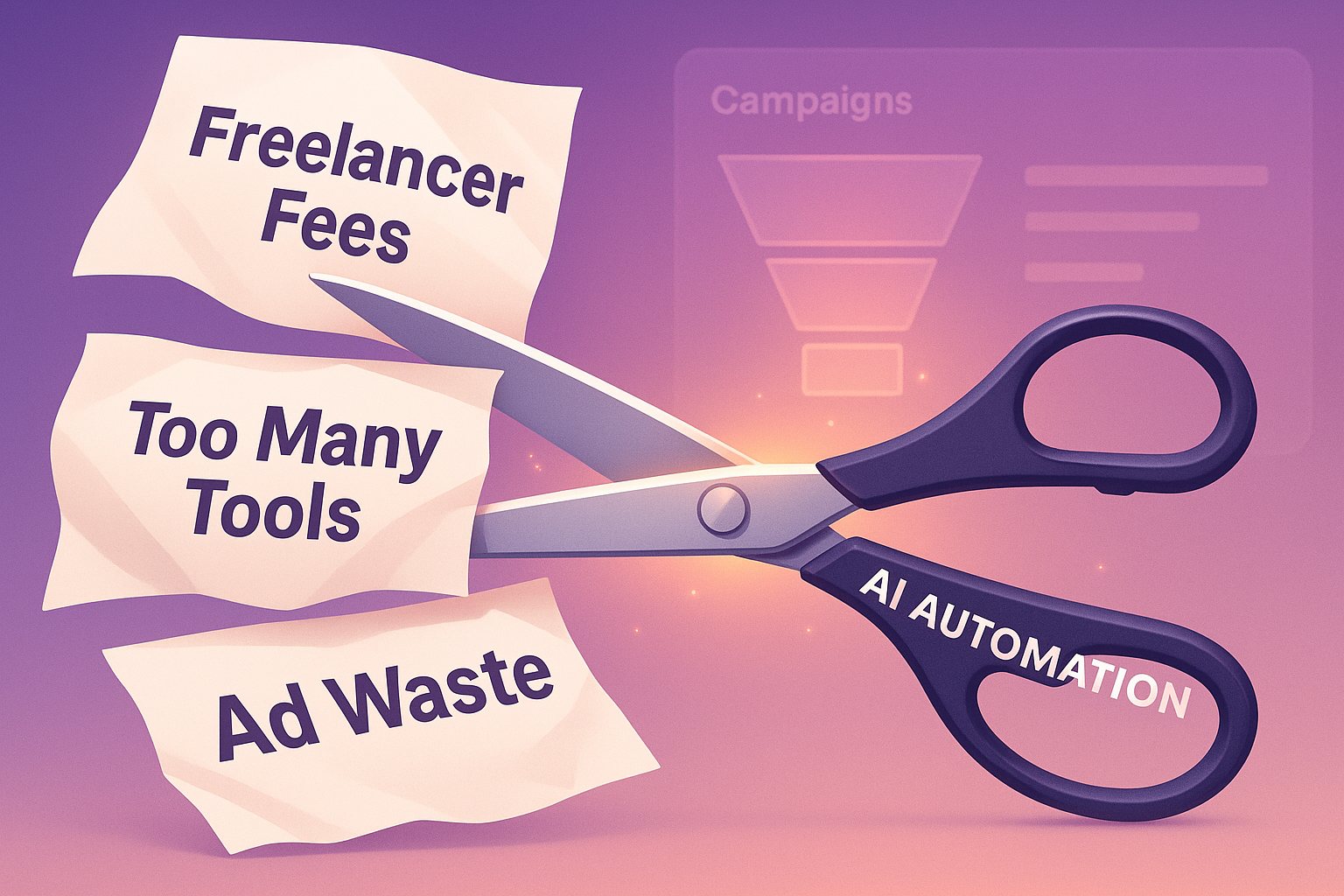
    • Overpriced freelancers or agencies for basic tasks

    • Bloated marketing software stacks with overlapping tools

    • Random, one-off ad spend without a clear funnel or plan

    • Manual tasks like reporting, scheduling, or keyword research

    • Content without a clear strategy or repurposing plan

    Sound familiar? The goal isn’t to stop doing these things—it’s to stop doing them inefficiently.

    Use AI to Cut Marketing Costs and Boost Efficiency

    Artificial Intelligence is no longer optional. It’s the ultimate cost-saver and force multiplier for lean teams. In fact, AI can reduce marketing costs by up to 40% while increasing campaign ROI.

    Enter: Discovr

    Discovr AI - AI Marketer

    Discovr is an AI-powered teammate that helps you plan, write, optimize, and publish content across SEO, social media, PR, and more. Instead of hiring a content strategist, copywriter, SEO analyst, and social media manager when fund are low or you’re just starting out—you get one intelligent system that handles it all.

    Whether you’re a CMO at a fast-scaling startup or a solo founder wearing all the hats, Discovr helps you cut marketing costs by:

    • Replacing 4-5 tools with one

    • Automating high-quality, human-sounding, and optimised content generation and publishing

    • Learning your brand voice, knowledge base, and goals to tailor messaging

    • Recommending strategy improvements in real-time

    Build a Lean, High-Impact Marketing Stack

    Most startups use 10+ tools for marketing. But research from Gartner shows that 58% of marketers say they’re underutilizing their existing martech stack.

    Here’s how to build a minimalist system that saves money and gets more done:

    Category Budget-Friendly Tools
    Content & SEO Discovr AI
    Social Scheduling Buffer, Publer, or Discovr again
    Email Marketing MailerLite, Gomailer, Discovr once again
    Analytics Google Analytics, Fathom
    Forms & Lead Gen Tally, Typeform, ConvertKit Forms

    The trick isn’t just picking cheap tools—it’s picking tools that do more than one job.

    Repurpose and Recycle Your Content Like a Pro

    Creating content from scratch every time is expensive. You don’t need new ideas—you need more mileage from existing ones.

    Here’s how to cut marketing costs through strategic repurposing:

    • Turn a blog post into a Twitter thread, LinkedIn post, and Instagram carousel

    • Convert webinars into blog content and short video clips

    • Use Discovr to generate SEO-friendly rewrites of old content

    • Create email newsletters from your best-performing blog posts

    Automate the Small Stuff That Wastes Your Time

    Manual work doesn’t just waste money—it drains your energy and creativity. Marketing automation can lead to a 14.5% increase in sales productivity and 12.2% reduction in marketing overhead. Start automating repetitive tasks like:

    • Scheduling social media posts

    • Sending email sequences

    • SEO audits and keyword clustering

    • Performance reporting

    Let Discovr AI Agents help you do these natively through its built-in automation flows.

    Focus on Strategy, Not Just Execution

    It’s tempting to focus only on execution when you’re trying to cut marketing costs. But without strategy, you’re just staying busy—not getting results.

    Great marketing strategy doesn’t cost more—it saves you from wasting money on the wrong things.

    Ask yourself:

    • Are we targeting the right customer segment?

    • Are our channels aligned with where our audience spends time?

    • Are we tracking the right KPIs?

    Discovr AI helps here too. It’s AI Agents don’t just generate content like an LLM would—it figures out the best strategies and content for your business, based your company profile, location, target audiences, products/services, etc.

    Outsource Strategically (Not Randomly)

    Freelancers can be amazing—if you’re hiring them for the right reasons. But don’t bring someone in to write five blog posts when Discovr can do the same faster, cheaper, and aligned with your voice.

    Instead, consider hiring for:

    • Brand design or identity

    • High-level campaign strategy

    • Community management

    • PR outreach

    Let tech handle the grunt work. Save your freelance budget for high-impact creative or strategic roles.

    Real-Life Example: How One Startup Cut 70% of Their Marketing Spend

    One early Discovr AI user, a bootstrapped Fintech founder, was spending over $3,000 on ads and tools. Within 3 months of switching to Discovr AI for SEO, they:

    • Increased organic lead generation by 370%

    • Started ranking for over 14 high-value keywords in 5 counties
    • Saved $2,100/month

    • Landed customers with a revenue surpassing $35,000

    • Reduced their tool stack from 5 tools to 1
    • Increased content output by 3x

    • Grew organic traffic by 47% in just 60 days

    This isn’t magic. It’s what happens when strategy meets smart automation.

    The Future of Cost-Efficient Marketing Is AI-Powered

    The most successful companies in the next 5 years will be those who learn to scale leanly. That means building smarter systems—not bigger budgets.

    Discovr AI is built exactly for that future. It’s not just a tool—it’s your AI marketing teammate. From content strategy to execution, it helps you scale your efforts without scaling your spend.

    Ready to cut marketing costs and grow smarter? Join the waitlist today.

    You don’t need deep pockets to build a powerful brand. You need clarity, systems, and the courage to embrace new tools like AI.

  • AIaaS vs SaaS: What’s the Difference and What Does It Mean for Your Business?

    AIaaS vs SaaS: What’s the Difference and What Does It Mean for Your Business?

    AIaaS vs SaaS: What's the Difference and What Does It Mean for Your Business? - Discovr

    AIaaS vs SaaS: What’s the Difference and What Does It Mean for Your Business?

    The acronyms are piling up. SaaS. IaaS. PaaS. AIaaS. It’s enough to make even the most seasoned expert pause with confusion. And rightly so. Understanding the difference between AIaaS vs SaaS isn’t just semantic—it’s strategic. It determines the tools you choose, the scale at which you operate, and how fast your business can grow in today’s AI-powered world.

    Whether you’re an early-stage startup building your tech stack or a growth-stage company looking to automate and personalise at scale, this guide breaks down AIaaS vs SaaS. We’ll explore how these models differ, how they overlap, and what they mean for your business—especially if you’re thinking about AI-powered tools like Discovr AI to automate your business.

    What is SaaS? The Software Foundation of Modern Startups

    Let’s start with what’s familiar: Software as a Service (SaaS). This is the cloud-based model where you pay for access to a software application hosted remotely, typically via subscription.

    Think of tools like:

    SaaS has been the go-to for businesses of all sizes because it offers scalability without massive infrastructure costs.

    But here’s the catch: SaaS apps are only as smart as the people using them. Most of them don’t “think” or “learn”—they simply provide a platform.

    This is where AIaaS (AI as a Service) comes in.

    What is AIaaS? A New Layer of Intelligence

    AI as a Service (AIaaS) is the next evolution. It provides access to powerful artificial intelligence capabilities—like machine learning, natural language processing, and predictive analytics—without needing to build those capabilities from scratch.

    AIaaS lets companies tap into:

    • Language generation

    • Predictive analytics and recommendations

    • Image and voice generation

    • Smart automation and personalization

    Companies that integrate AI into their operations could increase cash flow by up to 120% by 2030, compared to just 20% for slower adopters (PwC).

    The real kicker? AIaaS enables startups to access enterprise-level intelligence without building massive in-house teams.

    AIaaS vs SaaS: Key Differences That Matter

    Let’s break down the AIaaS vs SaaS conversation into digestible layers:

    Category SaaS AIaaS
    Function Provides software tools and features Provides intelligent, adaptive capabilities
    User Input Heavily dependent on human configuration Learns and adapts from user data and feedback
    Use Case Project management, CRM, email tools Personalisation, Predictive insights, content generation
    Skill Req. Low to medium (depends on tool) Higher technical understanding or guided platform

    Why This Matters for Startup Marketing

    In a high-noise, low-attention economy, marketing is make-or-break. SaaS marketing tools can help you manage workflows. But AIaaS tools can help you outperform your competitors.

    For example:

    • A SaaS tool might schedule your emails.

    • An AIaaS tools like Discovr AI will write an email, optimize the timing, and personalize it based on customer behavior.

    That difference? Massive.


    Discovr: Your First AI Marketing Employee

    Imagine hiring a full-stack content marketing teammate who:

    • Writes, optimises and posts your blog posts

    • Plans your social content

    • Optimizes your SEO strategy

    • Adapts campaigns based on data

    • Understands your brand tone and evolves with your company

    That’s what Discovr does. It’s not just a dashboard or an AI toy. It’s an AI Marketing Teammate. Discovr isn’t just SaaS or just AIaaS—it’s a hybrid. It provides the usability of SaaS with the adaptability and intelligence of AIaaS.

    For early-stage startups, this means saving time and hiring budget. For growth-stage businesses, it means achieving scale without compromising on personalization or content quality.


    AIaaS vs SaaS: When Should You Use Each?

    Use SaaS when:

    • You need standardized tools (CRM, task boards, HR platforms)

    • Your workflow is stable and repeatable

    • AI is not central to the product’s purpose

    Use AIaaS when:

    • You need to personalize at scale

    • You want to predict and act on user behavior

    • You lack data science resources but still want AI-powered insights

    💡 Pro tip: Many modern stacks will include both. Think of SaaS as your infrastructure, and AIaaS as the intelligence layer.


    Future of AIaaS vs SaaS: Are We Moving Beyond the Acronyms?

    As the lines blur, many platforms are combining the best of both worlds. You’ll see more hybrid tools that offer the usability of SaaS with the power of AIaaS baked in.

    According to a report by IDC, the AI software market—including AIaaS—is projected to grow from $64 billion in 2022 to over $251 billion by 2027. Businesses that don’t adapt will find themselves outmaneuvered by smarter, leaner competitors.


    Questions to Ask Before Choosing AIaaS or SaaS

    Before you commit to a platform, ask:

    1. What problem am I solving?

    2. Do I need static tools or adaptive intelligence?

    3. How tech-savvy is my team?

    4. Will this platform scale as I grow?

    5. Can this tool integrate or communicate with my current stack?

    Spoiler: Discovr AI checks all five boxes.


    Real-World Use Case: Marketing Campaign in Action

    Let’s say you’re a startup launching a new product.

    With a SaaS tool:
    You’ll use something like Mailchimp to send out emails, a Trello board to manage tasks, and maybe hire a freelancer to write your blog.

    With Discovr AI:

    • Discovr strategises

    • Plans the campaign

    • Creates optimized content

    • Schedules across channels

    • Recommends iterations

    That’s not just software—that’s intelligence applied at scale.

    Final Thoughts: Choosing the Right Tools for the Right Stage

    When it comes to AIaaS vs SaaS, the question isn’t which one is better—it’s which one suits your growth strategy right now. Early-stage startups can benefit from lightweight, intelligent tools that get them off the ground. Growth-stage companies need platforms that scale with their goals.

    In both cases, the future is AI-infused.

    If you’re serious about scaling your marketing without burning out your team or your budget, it’s time to meet your new AI teammate.


    👉 Ready to see Discovr AI in action?
    Let your first AI marketing employee help you plan, create, and scale—just like a real team member.

  • If you’re scared AI will take your job… READ THIS

    If you’re scared AI will take your job… READ THIS

    If you’re scared AI will take your job… READ THIS

    Have you ever found yourself tossing and turning at night, worrying if AI will take your job?

    You’re definitely not alone! For small to mid-sized businesses (SMBs), startups, and many enterprises, the rise of artificial intelligence tool and AI agents in the workplace can feel like a double-edged sword. While some see it as a looming threat, savvy entrepreneurs are beginning to realize that AI is not just a buzzword—it’s a powerful tool waiting to be harnessed.

    In this blog post, we’ll explore why the future isn’t as bleak as it seems and how you can leverage AI to not only secure your position but also to thrive in a rapidly evolving landscape.

    Understanding the AI Landscape

    AI is transforming industries at lightning speed. AI adoption has the potential to increase global GDP by as much as 1.2% annually. For context, the average world GDP growth rate over the past 10 years has been approximately 3.0% per year. According to data from the International Monetary Fund and World Bank. This incredible statistic highlights the sweeping impact AI will have across various sectors like e-commerce, technology, healthcare,  and marketing.

    Instead of feeling daunted by its rise and impending changes, it’s essential to understand how AI tools can work in tandem with humans.

    Why You Shouldn’t Fear AI Taking Your Job

    Let’s dismantle the notion that AI will take your job; instead, consider it a chance for growth. Here are several reasons why:

    • AI as a Collaborator: Think of AI not as a replacement, but as an invaluable team member. By taking over repetitive tasks, AI frees you up to concentrate on strategic planning and creative problem-solving. The best part? AI frees up time for you to have more time for your personal dreams and goals.
    • Upskilling Opportunities: The rise of AI is leading to a heightened demand for skilled workers. Embrace this change by expanding your skill set in areas that machines can’t touch—like emotional intelligence and complex decision-making.
    • Enhanced Customer Experience: AI can revolutionize customer interactions by personalizing them to fit individual needs. Companies utilizing AI-driven customer service report a 23% increase in customer satisfaction, proving that AI enhances rather than eclipses human roles.

    Ways AI Can Enhance Your Business

    Drawing from your own experiences, you can seamlessly integrate AI into your business. Here’s how to get started:

    • Streamlining Operations: Employ AI tools like chatbots to handle customer inquiries, allowing your team to devote more time to tackling complex issues.
    • Data-Driven Decisions: Leveraging AI’s ability to rapidly analyze customer behavior and market trends can give your brand a leg up. Use these insights to adapt your strategies in real time and better meet customer needs.
    • Content Creation: AI can assist in generating ideas and even drafts for your marketing content, enabling you to focus on refining and personalizing the final output.

    The Future of Work in an AI-Driven World

    Conversations about AI will take your job often miss an important point: the future is about collaboration, not replacement. A report from the World Economic Forum suggests that 85 million jobs may be displaced by a shift in labor division, but it also predicts 97 million new roles will emerge by 2025. This reality calls for a forward-thinking mindset where businesses adapt and innovate alongside technological advancements.

    Strategies to Stay Relevant

    You definitely don’t want to be left behind in this AI-driven market. Here are some practical strategies to ensure your skills and your business remain relevant:

    • Continuous Learning: Invest in upskilling yourself and your team. Numerous online courses are designed to make your workforce AI-savvy and ready for tomorrow’s challenges.
    • Networking: Forge connections with other SMBs and startups in your industry. Create alliances that foster knowledge-sharing about the latest AI applications.
    • Experiment with AI: Don’t wait for full-scale adoption. Start small with AI tools to get a feel for their benefits and limitations before diving in headfirst.

    Embracing Change

    Change can certainly be daunting, but remember: technological evolution has always been part of our journey. Rather than worrying that AI will take your job, see it as an opportunity to unlock new ventures and untapped potential. Leaders who confront challenges head-on, adapt boldly to new contexts, and prioritize employee growth will be the ones leading the charge of upcoming innovations.

    The narrative surrounding AI is evolving, and small and mid-sized businesses can emerge as frontrunners in this revolution, breaking free from traditional constraints. Don’t spend your time pondering if AI will take your job. Equip yourself with the knowledge, strategy, and mindset to effectively harness AI’s power.

    Take that first step toward transformation by exploring AI tools relevant to your business today! Start your journey with us at Discovr and revolutionize your marketing department.

  • How to Become an AI Marketing Manager

    How to Become an AI Marketing Manager


    How to Become an AI Marketing Manager

    Between over the next 5 years, the marketing profession and entire industry is rapidly change. The role of an AI Marketing Manager has grown in demand. We predict this role will become even more prominent in the coming years. As startups strive to scale efficiently, integrating artificial intelligence into marketing strategies is no longer optional—it’s essential for growth. This guide will walk you through the steps to become an AI Marketing Manager, equipping you with the knowledge and tools to lead your startup’s marketing efforts into the future.


    Why AI Marketing Managers Are in High Demand

    The integration of AI into marketing has transformed how businesses operate. According to a SurveyMonkey report, 88% of marketers now use AI in their daily roles, leveraging it for tasks ranging from content optimization to customer segmentation. This shift has created a demand for professionals who can bridge the gap between traditional marketing and AI-driven strategies.

    An AI Marketing Manager is responsible for:

    • Implementing AI tools to enhance marketing campaigns
    • Analyzing data to inform strategic decisions
    • Personalizing customer experiences through machine learning
    • Collaborating with cross-functional teams to align AI initiatives with business goals.

    Startups, in particular, benefit from AI Marketing Managers who can maximize limited resources and drive growth through intelligent automation.


    Essential Skills for an AI Marketing Manager

    To excel as an AI Marketing Manager, you need a blend of technical and soft skills:

    1. Understanding of AI and Machine Learning

    A deep understanding of AI technologies is crucial. This includes knowledge of machine learning algorithms, natural language processing, and predictive analytics. These skills enable you to select and implement the right AI tools for your marketing needs.

    2. Advanced Analytical Skills

    The ability to analyze complex data sets is essential. You must extract meaningful insights to drive decision-making and measure the effectiveness of marketing campaigns.

    3. Strategic Content Creation

    Creating content that resonates with your audience requires a balance of creativity and data-driven strategies. Using AI insights to craft personalized content can significantly enhance engagement and conversion rates.

    4. Customer Experience Optimization

    Enhancing customer experience through AI involves designing initiatives that anticipate customer needs and personalize interactions. This approach increases satisfaction and builds brand loyalty.

    5. Technical Proficiency

    Familiarity with marketing technology stacks, including AI and automation platforms such as Discovr, is vital. Being comfortable navigating these technologies allows you to execute campaigns effectively and optimize marketing efforts.


    Steps to Become an AI Marketing Manager

    Step 1: Build a Strong Foundation in Marketing

    Start by gaining experience in traditional marketing roles. Understand the fundamentals of marketing strategies, customer behavior, and campaign management.

    Step 2: Acquire Technical Knowledge

    Learn about AI and machine learning through courses, certifications, and hands-on projects. Platforms like Coursera, edX, and Udacity offer specialized programs in AI for marketing.

    Step 3: Gain Experience with AI Tools

    Familiarize yourself with AI-powered marketing tools such as:

    • Discovr: A virtual AI marketing teammate that strategizes, plans, and executes marketing content across various channels.
    • ChatGPT: Assists in content creation and customer engagement.
    • HubSpot: Offers AI-driven analytics and automation features.
    • Marketo: Provides AI-based lead scoring and campaign management.

    Hands-on experience with these tools will enhance your ability to implement AI solutions effectively.

    Step 4: Stay Updated with Industry Trends

    The field of AI in marketing is constantly evolving. Follow industry blogs, attend webinars, and participate in professional communities to stay informed about the latest trends, tools, and best practices.


    The Role of Discovr in Your Journey

    As you transition into the role of an AI Marketing Manager, Discovr can be an invaluable asset. Designed to function like a real team member, Discovr learns from your data, adapts to your brand, and personalizes your campaigns. It helps you strategize, plan, and execute marketing content across copywriting, SEO, social media, PR, and content marketing.

    By integrating Discovr into your workflow, you can:

    • Automate repetitive tasks
    • Enhance content personalization
    • Improve campaign efficiency
    • Scale your marketing efforts without expanding your team

    Explore how Discovr can support your growth at Discovr.

    Becoming an AI Marketing Manager is a strategic move that positions you at the forefront of modern marketing. By developing the necessary skills, gaining experience with AI tools, and staying informed about industry trends, you can lead your startup’s marketing efforts into a data-driven future. Embrace the power of AI and take the first step toward transforming your marketing career.


    Evolve with Discovr

    Discovr is at the forefront of the AI marketing movement, offering a AI marketing automation Agents that serve as a virtual marketing teammates. It strategizes, plans, and executes marketing content across various channels, including copywriting, SEO, social media, PR, and content marketing.

    For further insights into AI’s impact on marketing, consider reading SurveyMonkey’s AI Marketing Statistics.


    Unleash the Power of a Virtual AI Marketing Employee

    Discovr is a virtual AI marketing teammate that strategises, plans, and executes your marketing content. It adapts to your brand and personalises your campaigns to help your team scale faster

  • What Exactly is Vibe Marketing in 2025?

    What Exactly is Vibe Marketing in 2025?


    What Exactly is Vibe Marketing in 2025?

    In 2025, marketing as we know it is undergoing a seismic shift. Traditional and legacy methods are giving way to innovative approaches that leverage artificial intelligence (AI) to streamline processes and enhance creativity. One such approach gaining traction is vibe marketing.

    Understanding Vibe Marketing

    It is an AI-driven strategy that enables individuals or small teams to execute comprehensive marketing campaigns with the efficiency and effectiveness of a full-scale agency. By harnessing AI tools, marketers can automate tasks such as content creation, campaign optimization, and audience targeting, allowing for rapid deployment and real-time adjustments.

    This approach is particularly beneficial for startups, small and medium businesses, and marketing agencies looking to maximize output without proportionally increasing resources.

    Where did it come from?

    Several factors have contributed to the emergence of vibe marketing:

    • Advancements in AI Technology: AI has reached a level where it can perform complex marketing tasks, from generating content to analyzing consumer behavior.
    • Accessibility of No-Code Tools: The proliferation of user-friendly, no-code platforms allows marketers without technical backgrounds to implement sophisticated AI solutions.
    • Cost Efficiency: AI tools reduce the need for large teams, lowering operational costs while maintaining, or even improving, campaign quality.

    According to a report by CoSchedule, over 55% of marketers in 2025 trust AI-generated content and insights, highlighting the growing confidence in AI’s capabilities within the marketing sector.

    Vibe vs. Traditional Marketing

    The traditional marketing model often involves siloed departments and lengthy approval processes, leading to slower campaign rollouts. In contrast, vibe marketing promotes agility and cross-functional collaboration, enabling faster response times and more cohesive strategies.

    For example, a traditional campaign might take weeks to develop and launch, whereas a vibe marketing approach could achieve similar results in a fraction of the time, thanks to AI-driven automation and real-time analytics.

    Vibe with Discovr

    Discovr is at the forefront of the vibe marketing movement, offering an AI-powered marketing automation platform that serves as a virtual marketing teammate. It strategizes, plans, and executes marketing content across various channels, including copywriting, SEO, social media, PR, and content marketing.

    By learning from your data and adapting to your brand, Discovr personalizes campaigns to resonate with your target audience, helping you scale your marketing efforts efficiently.

    What does the Future Look like?

    As AI tech evolves, vibe marketing is poised to become the standard approach for businesses seeking to stay competitive in the digital landscape. Embracing this model allows for greater flexibility, improved customer engagement, and more effective resource use.

    For those interested in exploring the potential of vibe marketing, platforms like Discovr provide the tools and support necessary to transition smoothly into this innovative marketing paradigm.


    For more insights into the impact of AI on marketing strategies, consider reading this article on AI Marketing Statistics Every Business Leader Must Know in 2025.


    Unleash the Power of a Virtual AI Marketing Employee

    Discovr is a virtual AI marketing teammate that strategises, plans, and executes your marketing content. It adapts to your brand and personalises your campaigns to help your team scale faster